女子遭丈夫打死
In a Beijing hutong, old roots hold firm amid renewal_我的网站

一 | Texas Governor Greg Abbott has authorized his state’s National Guard and the Department of Public Safety to detain migrants who illegally cross the border between ports of entry and return them to US-Mexican border entry points.,The federal government is normally responsible for enforcement of immigration; Governor Abbott stressed in an executive order announced on Thursday that while US President Joe Biden “refuses to do his job and enforce the immigration laws enacted by Congress, the State of Texas is once again stepping up and taking unprecedented action to protect Americans and secure” the US southern border.,The governor referred to the US Constitution, which he said stipulates that the country “shall protect each [State in this Union] against [a border] invasion.”,The announcement comes after former Trump administration official Ken Cuccinelli said he wanted Abbott to declare an invasion and enact a Title 42-style program, which envisages migrants being “repealed at the border” and automatically turned away.,Cuccinelli’s remarks followed US authorities saying in late June that at least 51 migrants had died after being trapped inside a sweltering tractor-trailer truck found abandoned in Texas. The deceased 39 men and 12 women were discovered on the outskirts of San Antonio, in what became one of the deadliest human trafficking tragedies in recent history.,At the time, Abbott pointed the finger at the “open border policy”, pursued by Biden, who in turn said that the incident “underscores the need to go after the multi-billion dollar criminal smuggling industry preying on migrants and leading to far too many innocent deaths.”,The Biden administration is grappling with increasing border arrivals as US Customs and Border Protection (CBP) data revealed in mid-June that that Border Patrol agents apprehended 239,416 illegal migrants on the US southern border in May, a new record high.,'Doing Nothing': Border Patrol Union Chief Rips Biden Migrant Policies for 'Benefiting Smugglers'2 April, 14:25 GMT,This year, the number of illegal migrants detained every month on the US’ southern border hit two record highs, in March and April, 222,339 and 235,478, respectively, according to CBP.,In a separate development in March, Biden told migrants not to come to US, insisting that there had been a surge in immigration "in the last two years", but that that the current rise "could be" worse.,Former US President Donald Trump, for his part, argued at the time that Biden had "eroded" the successful system that Trump had put in place, and that his policies "were working better than they have ever seen on the southern border.",The crisis on the US southern border began almost immediately after Biden took office in January 2021 and revoked Trump-era immigration policies, including the 45th president’s signature border wall and the “Remain in Mexico” program. Other measures, including promises to “restore and expand” the US asylum system, and to potentially provide a “path to citizenship” for more than 11 million undocumented immigrants already residing in the US, led to a further surge in entry attempts.。

二 |
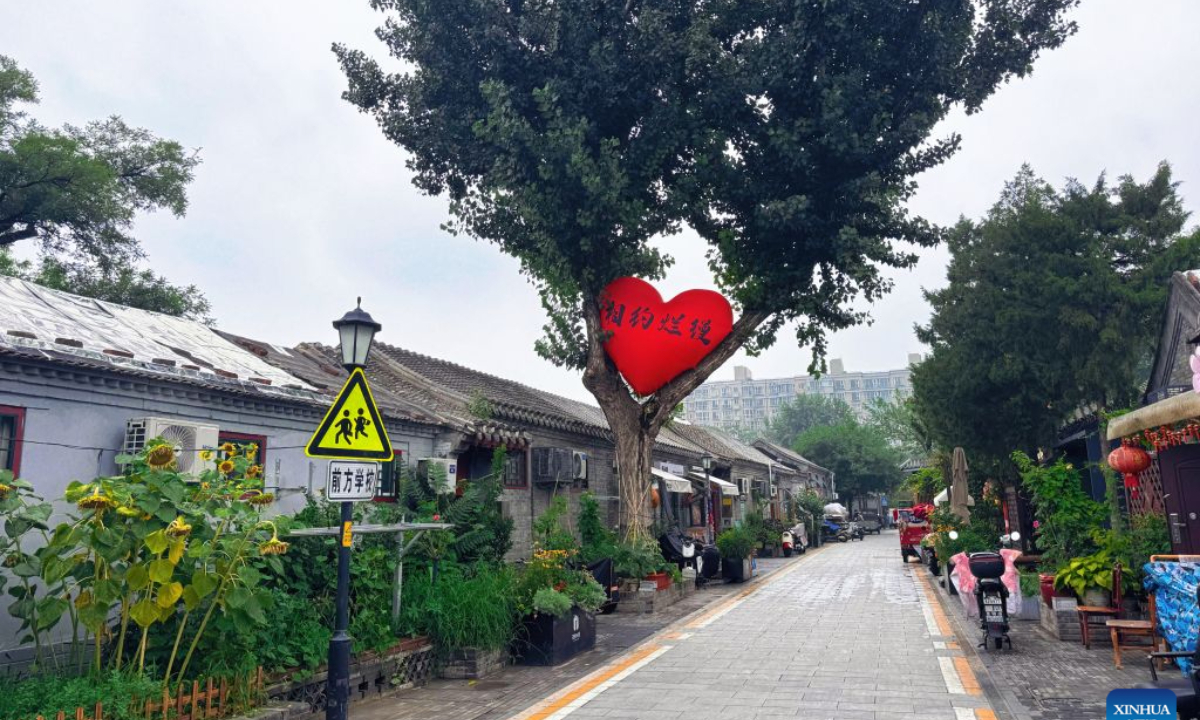
This photo taken on July 10, 2026 shows a view of Lanman Hutong in Beijing, capital of China. (Xinhua/Zheng Keyi)Just after six each morning, 63-year-old Chen Zhongyi unlatches the wooden door of a pigeon loft outside his home in Beijing's Lanman Hutong. Within seconds, more than 20 homing pigeons burst into the sky, circling above the grey-tiled roofs before fanning out across the city.
"That's when I feel happiest in the day," Chen said, his gaze following the birds as they fade from view.
For Chen, who has spent his entire life in this narrow alley, the pigeons are far more than a pastime. They embody a way of life that has long defined the character of Beijing's historic hutongs.
A city with over 3,000 years of recorded history, Beijing has constantly grappled with how to modernise without erasing its past. Lanman Hutong, tucked in the city's core, offers a compelling case study in urban renewal that honours neighbourhood memories while leaving room for the new.
OLD ALLEY, NEW LIFE
When Lanman Hutong launched a major renovation in 2018, Chen feared his hand-built pigeon loft, a fixture since 2013, might have to come down.
To his relief, the designers had other plans. "Pigeons are part of old Beijing's culture," they told him. "They should stay, and we'll upgrade the loft."
The birds were soon moved into a new wooden structure -- brighter, sturdier and better ventilated. "It wasn't just a new pigeon house," Chen said. "It told me that what we treasure can endure."
He was not alone in witnessing the change. Zheng Enqing, 78, who has lived in the neighbourhood for over three decades, recalled the alley's former chaos: cars crammed into every available space, pedestrians squeezing past.
Today, the rough pavement has given way to neatly laid grey bricks, and a nearby multi-story parking facility has freed the lane for foot traffic.
Yet for Zheng, the most telling improvements were those shaped by residents themselves.
When an outdoor air-conditioning unit began blasting hot air onto his prized grapevine, he raised it with the neighbourhood committee.
"They listened," Zheng said, noting that this responsiveness, for him, defined the entire renewal. The unit was moved to the rooftop and screened with a structure that blends with the historic surroundings.
"Our goal was to improve the environment while letting residents keep their way of life," said Chen Qinghong, planning manager at Beijing DeYuan Dade Real Estate Investment Co., Ltd., the project developer.
Chen added that over 100 consultation meetings were held with locals before and during construction, covering everything from parking to landscaping and public facilities.
"Urban renewal should not ask residents to adapt to redevelopment," said Song Jingyang, an official with the Beijing Municipal Commission of Urban Management. "Rather, redevelopment should adapt to the people."
A LIVING COMMUNITY
For planners, however, upgrading the physical fabric was only the first step.
In 2023, Lanman Hutong introduced a voluntary relocation program, letting residents decide whether to stay or leave. Vacant courtyards were then gradually opened to businesses and cultural ventures suited to the historic district's character.
By early 2026, 641 households in the Fayuan Temple Historic District, where Lanman Hutong sits, had opted for relocation, making room for 105 new businesses. Cafés, bookshops, restaurants and cultural studios have since taken root in centuries-old courtyards.
Zheng, who chose to stay, admitted that the newcomers have shifted his outlook. "At first, I thought cafés were only for young people. Now I believe we older residents should also embrace these changes," Zheng said.
He is also cheered by the growing number of young faces in the alley. "That's exactly the kind of change we want to see," he said.
Among them is 23-year-old Hu Feixiong, a graduate student at Beijing University of Civil Engineering and Architecture.
Earlier this year, Hu and his teammates moved into a youth entrepreneurship space in Lanman Hutong, where they began offering architectural cultural products, including layered refrigerator magnets inspired by Beijing's landmarks, directly to customers in a real neighbourhood.
"We only pay basic utility costs, yet we can meet customers, test our products and refine our ideas in a living community," Hu said. Rather than remaining on design sketches or screens, their creations now reach visitors face-to-face in one of Beijing's oldest quarters.
In this way, the city's architectural heritage endures not just through preservation but through the ingenuity of a new generation.
"It is the interaction among residents, businesses and the community that keeps a neighborhood alive," said Wang Mingjun, an official with the Xicheng District Urban Management Committee. "Urban renewal is not a one-off project. It is an ongoing process in which everyone has a role to play."
Official data show that since 2017, more than 5,200 backstreets and alleys in Beijing have undergone environmental upgrades, with resident satisfaction steadily rising.
That approach reflects a broader shift across China. In Jinfeng Town, southwest China's Chongqing Municipality, for instance, residents are pinning their hopes on ongoing renewal projects to raise living standards further.
Under the urban renewal plan for the 15th Five-Year Plan period (2026-2030), China aims by 2030 to build cities that deliver a high quality of life for all -- a vision that, in Lanman Hutong, is already taking shape.
。
Current article:http://4iupwun.xuanliaruamibinmilangca.shop/0qir2o/20260826/251313.html
Published on:19:57:06